


Innovations in adolescent health and well-being are happening all around us, but without strong communication of what makes them significant, even the best ideas may never reach the young people they’re designed for. That’s where branding comes in.
At Breakthrough Accelerator, we see branding as encompassing more than just good design. Rather, it’s a key part of translating evidence-based ideas into real-world impact. From the start, our approach to branding has been intertwined with a commitment to reach people effectively and convert science from theory into everyday practice. We also incorporate this commitment throughout the innovation lifecycle by working with our innovation development teams (IDTs) to develop clear, compelling brand identities that build credibility, connect with audiences, and communicate the value of the work. Using branding to share insights into your process can help build an audience that not only benefits from your adolescent health innovations but is also excited to join your journey.
At Breakthrough Accelerator, it was important to us to build a brand identity from the start. As communications professionals, we appreciate that the larger Breakthrough team understood the importance of investing in branding early and often. Clear branding not only increases awareness of our project among those who might benefit from its innovations, but also helps build a reliable reputation for the IDTs we support. Further, branding supports our larger mission of translating the science behind the innovation teams’ projects, showing how they test and reiterate to gain a greater understanding of the issues at hand and develop impactful products.
From the start, we tried to visually express how Breakthrough would serve as a friendly, supportive professional growth opportunity for innovators in the field. Visually, our logo represents these concepts—from a color palette reflecting a rising sun motif to show new beginnings and opportunities, to the upward arrow pointing to a spark that indicates how the program focuses on forward progress, group growth, and creative innovation.
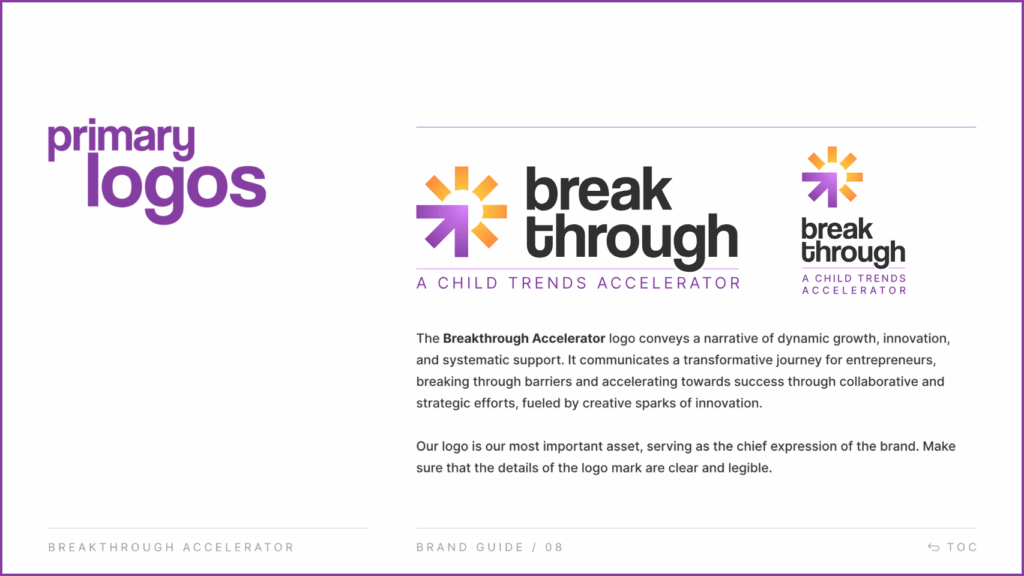
A page from Breakthrough’s brand guide that discusses the importance of the logo in visually representing our vision and mission. Breakthrough worked with a design firm to create the logo and develop branding guidance.
As we welcomed our first cohort of innovators in August 2024, we focused on building the other two core components of branding: voice and feel. The voice of Breakthrough’s branding reflects our core motivation. We center our IDTs wherever possible so they can transform their science-backed projects into societally impactful work. This dedication came to life in multiple ways—from using engaging formats to feature teams and their projects individually on social media, to drafting templates to make it easier for teams to create engaging blog posts and share firsthand perspectives about their own work.

A social media graphic featuring one of the innovative teams, Up to Us.
We also expanded on the feel of Breakthrough’s brand to consider how we wanted our audience to interact with the program. We aimed to engage not only adolescent health practitioners, program leaders, and researchers, but also youth themselves. For example, we used conversational, everyday language in social media posts, newsletters, and other public-facing communications, a practice that avoids scientific jargon and makes complex ideas easier to approach and understand. Our graphics are intentionally bright and easy to comprehend, and we occasionally reference pop culture—after all, we’re a brand all about teens and supporting new ideas!
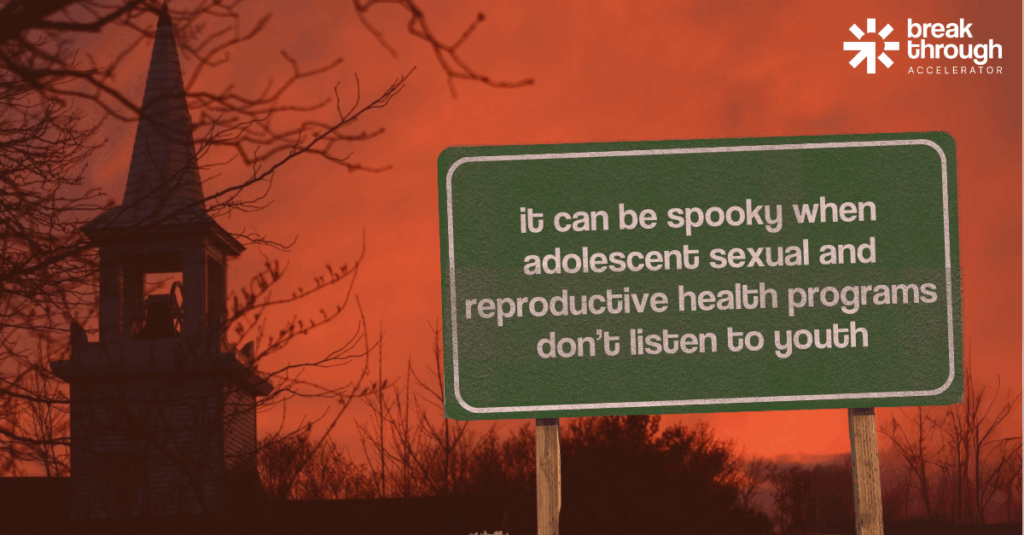
A social media post referencing a pop culture representation of Halloween to share Breakthrough’s resources and motivations in a modern, authentic way.
While these elements are integral to Breakthrough, we also want our IDTs to walk away with the knowledge and skills to apply similar branding and marketing practices to their own innovations. While each team joins our program from a different place, we cater our trainings to expand on their work, no matter where they are in the process. To do this, we delivered a two-part virtual training course to IDTs, focusing on the same branding principles that we ourselves prioritize. In the training, we presented on how to build a brand and introduced a whiteboard tool that teams could use to brainstorm the look, feel, and voice of their innovation. Teams were able to work individually with coaches and communication specialists during the webinar and received additional technical assistance around branding and marketing from specialists later in the training.
Over the course of our accelerator program, all five IDTs in the first cohort began creating (or refining their approach to creating) their brands by selecting a look to visually represent their project and identifying a feel that catered to who they wanted to reach. Some teams, like the Stigma RPG and ATLAS, worked with designers and artists to craft logos that fully encompassed their messaging through color and symbology. Others had already done branding work and used this as an opportunity to build out communication products, such as HBCU Wellness Collective’s website and Up to Us’ Instagram. All teams, including Beyond the Bump, used this opportunity to develop their brand’s online presence.
Building your brand while having an idea that’s grounded in science is the key to effective outreach and change. For more on this subject, check out our 10 recommended resources on communicating science effectively:
- What Is Science Communication? | Video by Utah Valley University
- Communicating Effectively in a Scientific Environment | Video by Utah Valley University
- Science Communications Matters and How to Do It Better | Video by TedTalk
- How Science Communication Helps Us Be Fully Ourselves | Video by TedTalk
- What Is Branding? Understanding Its Importance | Blog post by HubSpot (with a free, downloadable brand building guide)
- 9 Tips For Communicating Science To People Who Are Not Scientists | Article by Forbes
- American Association for the Advancement of Science (AAAS) Communication Toolkit | Article and toolkit by AAAS
- Design and Develop Accessible Products | Digital guidance website by the General Services Administration
- Create Accessible Digital Products | Digital guidance website by the General Services Administration
- Child Trends’ Approach to Strategic Communications | Webpage by Child Trends
Suggested citation: Stowers, M., Zarick, L. (2025). Building the brand of an adolescent health innovation program. Breakthrough Accelerator. https://breakthrough.fund/building-the-brand-of-an-adolescent-health-innovation-program/