



As part of Breakthrough’s training workshops, we ask innovation teams to identify their long-term goals, including the specific positive impacts they want to have on young people. Our Cohort 2 innovation teams envision impacts that include increasing the use of health care services by college students, building parenting confidence among young moms, and increasing safer sex practices among teens.
As you can see, the Breakthrough innovators like to think big! They want to make a real difference in adolescent sexual health. How can our teams be confident that their innovations will make the changes they’re hoping to see?
Answer: They created a theory of change.
What’s a theory of change?
A theory of change lays out what an innovation is doing, what is expected to change by implementing the innovation, and why those changes should be expected to happen. A theory of change should identify the pathway from activities to long-term goals, and it should be grounded in existing evidence and/or theory.
Theories of change can take many formats; they can range from a single sentence to a few paragraphs, be purely text-based, or incorporate graphics. To help our teams create a theory of change, Breakthrough provides the following format to teams as a starting point:
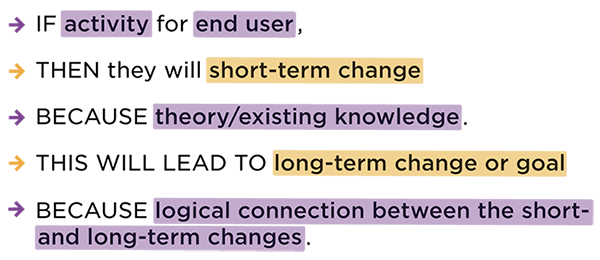
To help teams understand how to create their own theory of change, we share a few examples following this general format. The following is a hypothetical theory of change for one type of intervention experienced by adolescents all around the United States—driver’s license restrictions based on age:
If teenage drivers have license restrictions regarding nighttime driving and having passengers for their first six months, then they will be involved in fewer dangerous or distracted driving situations as new drivers because there are penalties for violating these restrictions. This will lead to fewer accidents and deaths involving teen drivers because they are less likely to engage in distracted driving at the time that they are the most inexperienced drivers.
This theory of change makes sense, right? It successfully connects the activity (driver’s license restrictions) and the long-term goal (fewer accidents). It starts by drawing the short-term connection: The risk of being ticketed or fined for having a passenger or for driving at night during this period decreases the likelihood of those behaviors. We can cite theory/existing knowledge—in this case a theoretical framework such as the Theory of Planned Behavior—to support this pathway. This short-term behavior change, in turn, decreases the likelihood of crashes during the provisional license period.
Here’s how one of our Breakthrough Cohort 2 innovation teams applied this theory of change format to their adolescent health innovation.
If we provide adolescents with scaffolding for conversations around sexual health, mental health, and their intersection through game play, then they will engage with these topics personally because practicing conversations in a fun, facilitated way makes adolescents comfortable with and curious about these topics. This will lead to improved relationships and better sexual and mental health, because increased comfort and curiosity about these topics will promote ongoing knowledge building and connection-seeking—which support mental and sexual well-being.
You’ll notice this theory of change does several things effectively. It has a compelling first “because” statement that leans on the fact that the innovation is fun and seeks to build comfort and curiosity. The second “because” statement can be supported by theoretical frameworks such as Self-Determination Theory and Social Support Theory. It also describes compelling long-term outcomes: improved sexual and mental well-being, as well as improved relationships. Many can relate to these issues, making the theory of change—and the innovation itself—feel relevant.
What makes a good theory of change?
A good theory of change is clear, compelling, and grounded in theory and/or existing evidence.
1. A good theory of change is clear.
Innovations have multiple activities. A theory of change should provide a good sense of how the innovation tackles the key problem—not describe every detail.
For example, an innovation might include structured peer discussions, a take-home guide for adolescents to use in talking with their parents, and weekly social media activities. Not everything needs to be listed in the theory of change. A summary statement could read, “If adolescents are encouraged to have structured peer and family discussions, supplemented by social media content …”
2. A good theory of change is compelling
In the adolescent health innovation space, the expected goals in a theory of change should convey that the innovation will lead to tangible improvements in the health of young people. What is the innovation achieving in the long-term?
For example, an innovation might build young people’s comfort asking potential partners about STI testing and advocating for condom use. While this is important, the theory of change should connect it to a tangible health outcome. The developer might frame the long-term change as “increased condom use when STI status is uncertain and reduced STI transmission among youth.”
3. A good theory of change is grounded in theory and/or existing evidence.
An innovation’s activities, short-term changes, and long-term changes should be clearly connected, and these connections should hold up to scrutiny. Are the “because” statements aligned with existing knowledge or theory? If not, an innovator may have to revisit the innovation’s activities and goals.
Existing theories or frameworks about health behaviors can support or help clarify the pathways in a theory of change. These include but are not limited to: Ecological Systems Theory, Social Cognitive Theory, and the Theory of Planned Behavior.
Innovators can also turn toward existing research or program evaluations related to their innovation approach, outcomes of interest, or theorized pathways to lend support for their theory of change.
For example, an innovation’s activities consist of a browser plug-in that automatically spots and fact-checks sexual health misinformation. However, a short-term change the developers desire is increased uptake of sexual health services. Evidence from existing interventions and theoretical frameworks does not support the connection between simply clarifying misinformation and motivating adolescents to seek sexual health care. Therefore, the developers added a local resource finder and scheduling helper to their browser plug-in.
What do innovators do with a theory of change?
A theory of change is a foundational document of an innovation. It summarizes what your innovation is, what it seeks to achieve, and why it might work. Having a solid theory of change is key for partnership-building, fundraising, and scaling. It’s also useful for internal innovation design work. When thinking about adding or removing a component or engaging a different end user, it’s always helpful to ask: “Is this in line with the theory of change?”
That said, a theory of change is a living document. When an innovation evolves (and it’s a fact of life that innovations change), when innovators adjust their assumptions, or when the path from activities to long-term change turns out to be different than expected, those are all times to update the theory of change. It should grow with the innovation, not restrict it.
Suggested citation: Beckwith, S., & Welti, K. (2026). Building a theory of change for adolescent health innovations. Breakthrough Accelerator. https://breakthrough.fund/building-a-theory-of-change-for-adolescent-health-innovations/